
How Can We Help?
Start with your HMI
Power Supply
- 24 VDC: 3.5″ 4.3″ 7.0″ 10.2″ 15.6″
- 12/24 VDC: 3.5″ 4.3″ 7.0″
Mounting Cut-Out
- 3.5″ : 92 x 77
- 4.3″ :
- HM-043AE : 141 × 84
- HMI-043Uxx : 132 x 80
- 5.0″ : 157 x 95
- 7.0″ : 192 x 138
- 10.2″ : 259 x 201
- 15.6″ : 383 x 246
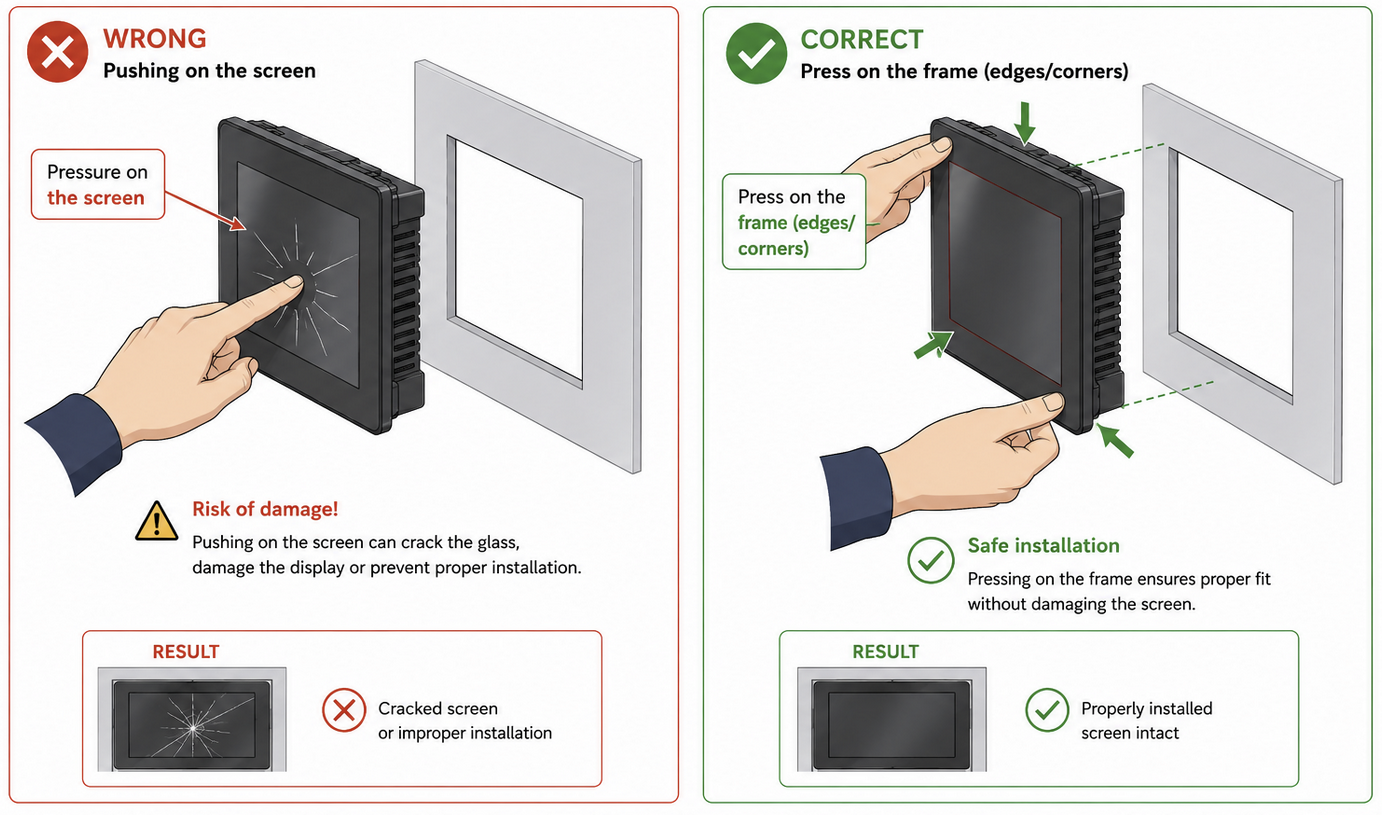
Positioning in the cut-out: The HMI must fit into the opening without applying force. Use the HMI frame to position it, not the screen itself.
USB Ports
USB-A

Used to connect:
- USB-HMI-ACE cable (with amplifier) to ACE PLC Mini-USB port (if RS232/485 port is not available)
- Note: there is no need to power the amplifier (jack plug)
- or a USB stick for other functions
Note: 3.5″ version has no USB-A port
USB-B or USB-C


Used only to download or upload a HMI project with CommandHMI software USB-B : First-generation HMIs USB-C : Second-generation HMIs
- For HMIs with a USB-C port, use a USB-A to USB-C cable
- The HMI does not support USB-C negotiation
- which means that a USB-C to USB-C cable will not work
- On the new HMI with a USB-C port, the USB-C and USB-A ports share the same internal USB controller. They therefore cannot be used at the same time.
- If a USB-A cable is connected, the project download via USB-C will not work.
- To download via USB-C:
- Unplug the USB-A cable.
- Unplug and reconnect the USB-C cable.
- Start the download.
- Use our USB isolator when connecting your PC to the HMI or ACE PLC in hard industrial environments to avoid potential difference issues between the two USB devices.
- First-generation HM-156QS models use only the Ethernet port to download an HMI project using the CommandHMI software
- See the ‘Ethernet’ section
RS232/485 Ports

Supports a wide range of protocols External view of HMI Sub-D9 male connector
| Pin | RS-232 | RS-422 | RS-485 |
| 2 | RX | ||
| 3 | TX | ||
| 4 | |||
| 5 | GND | ||
| 6 | RX- | ||
| 7 | RX+ | ||
| 8 | TX- | B- | |
| 9 | TX+ | A+ |
Use 1 shielded twisted pair for RS485 [A+]&[ B-]
Use 2 shielded twisted pairs for RS232 [RX]&[GND] and [TX]&[GND]
CBL-SC1 RS232 HMI cable (optional)
For ACE PLCs (Modbus RTU) or other RS232 PLCs/Devices. Colors of the wires:
- Red = HMI Pin 2 = HMI RX (to the TX pin of the ACE PLC)
- White = HMI Pin 3 = HMI TX (to the RX pin of the ACE PLC)
- Green = HMI Pin 5 = HMI GND = (to the GND pin of the ACE PLC)
ACE PLC RS232 small connector

Connection side with CBL-SC1 cable colours RX, TX and GND RS485 : [A+] [B-] [GND] Note: For ACE with RS485 (ACE-1430, ACE-1450,..) don’t forget to setup “RS485” in “Setup Hardware” of vBuilder

Ethernet RJ45 port

For HMIs with Ethernet RJ-45 port! Supports a wide range of protocols HM-156QS use only the Ethernet port for download or upload a HMI project with CommandHMI software. its default IP is 192.168.1.100 Used to connect:
- CommandHMI software for download or upload a HMI project. TCP port 12345. See in CommandHMI [HMI parameters settings] > [Printers/download]
- ACE gateways, HMIs or any PLCs/Ethernet devices
DIP switch on back of HMI (1st generation of HMIs)
- It is also possible to access “Parameter settings” on the HMI screen via a “Function Button” in the CommandHMI
- Or by keeping your finger on the touchscreen and then turning on the user interface


| DIP | 1 | 2 | 3 | 4 | 5 |
| Normal operation | OFF | OFF | OFF | OFF | OFF |
| Version information | OFF | ON | OFF | OFF | OFF |
| Parameter settings * (Clock, IP,…) | ON | OFF | ON | OFF | OFF |
| Touch calibration | ON | OFF | OFF | OFF | OFF |
15.6″ HMI VESA
HM-156QS HMI is compatible with VESA mount 100 mm (3.9 in) Caution regarding the use of screws: The screws must be metric type M4. Screw_length < Thickness_of_your_support + 4 mm
Start with CommandHMI Software
You can find CommandHMI on this support website page.
Download it, install it and connect the PC to the HMI USB-B or USB-C port
Open a new project Select the screen size, then the model, the link interface and the protocol (By default Modbus for ACE PLCs)
Variables in CommandHMI software
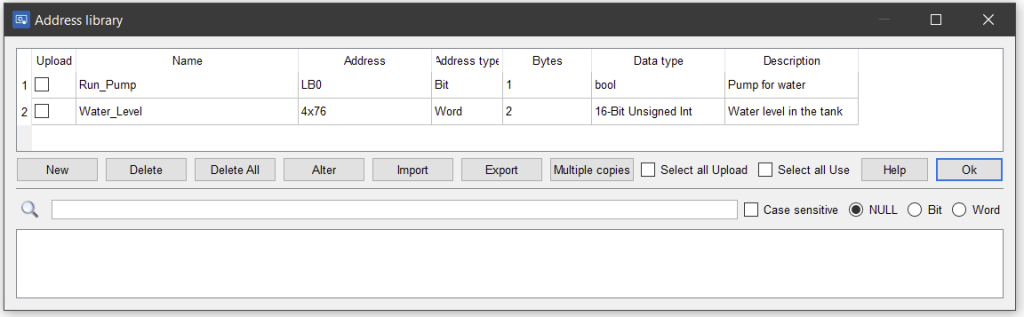
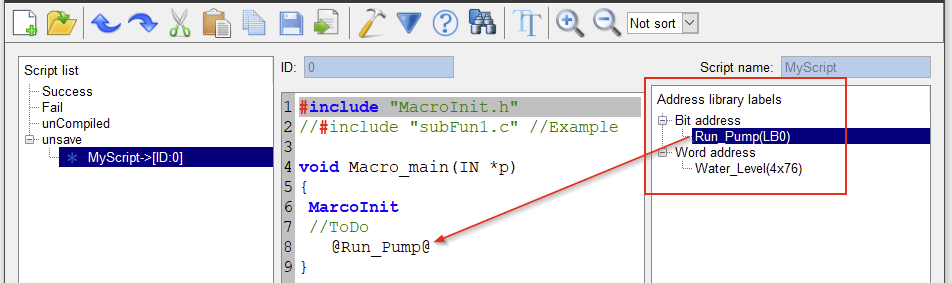
We suggest you use the “Address library” to define your variable mnemonics, so that you can use them not only on your various screen pages but also in your scripts
In “System Setting”
In “Script Editor”
CommandHMI with ACE PLC (Modbus device)
Link is COMx (RS232/485) or USB for ACE PLC Note: All ACE have a USB port but not necessarily a COM port Note: For USB it is advisable to use the USB-HMI-ACE to avoid communication errors Note: In the vBuilder programming software for ACEs, the tags must be ‘Writable’ to be writable by the Modbus master. Protocol is Modbus RTU Master
Bit switch/button

Select Bit switch, chose Function Invert and enter 0x0 for Write Address Note: With 0x0, you write a Bit to address 0 of the Bit register Confirm and draw your button on the screen
Numerical input

Select Numerical input and enter 4×0 for Write Address Note: With 4×0, you write a Word to address 0 of the Word register Confirm and draw your input field on the screen
Download your project to the HMI

 Note: If you have an error, please, reinstall the Windows driver
How to backup/save the internal ACE PLC tags (coder positions, counters,..) in the HMI ?
See https://www.support.aceautomation.eu/knowledge-base/how-to-backup-the-ace-plc-tags-in-the-hmi/